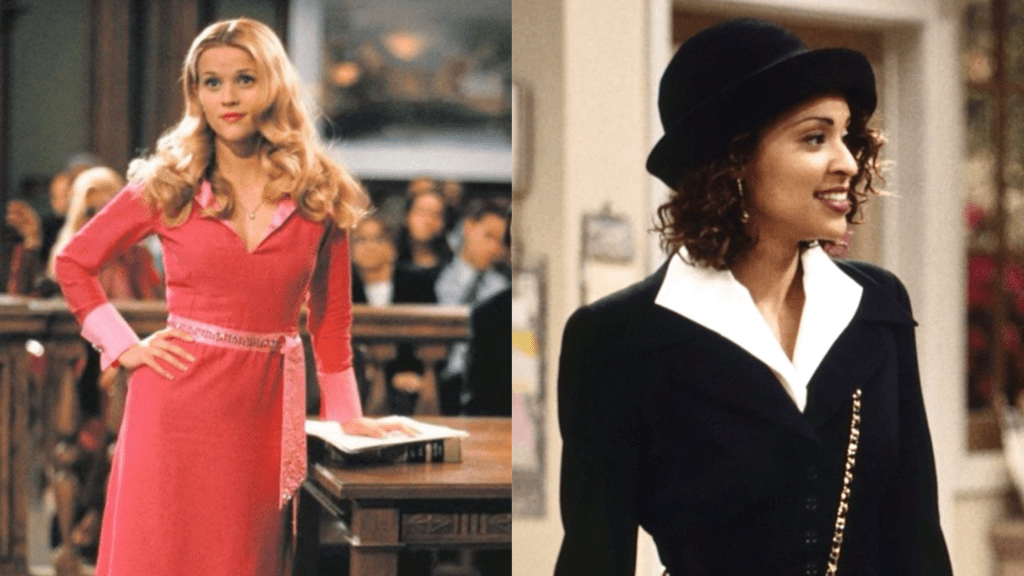
I would playfully say that Hilary Banks and Elle Woods raised me. On the surface, it sounds like a joke: a spoiled Black princess from Bel-Air and a pink-clad sorority girl who takes Harvard Law by storm. But the more closely we examine these characters, the more interesting the statement becomes. Both women were introduced through stereotypes that encouraged audiences and the people around them to underestimate them. Yet both became enduring examples of women who could love beauty, femininity, pleasure, status, and glamour without those interests canceling out ambition, intelligence, or substance.
Hilary Banks: The Woman Who Assumed She Belonged
When The Fresh Prince of Bel-Air premiered in 1990, Hilary Banks was frequently the joke. She was spoiled, materialistic, image-conscious, sheltered, and sometimes spectacularly oblivious. Karyn Parsons, who originated the role, has said that audience attitudes toward Hilary changed over time: viewers increasingly moved beyond laughing at her ditziness and began recognizing her ambition, confidence, and certainty about what she wanted [1].
That evolution matters because Hilary offered something unusually valuable in American television: a wealthy Black young woman who was allowed to be frivolous. Black female characters have often carried a heavy representational burden of strength, sacrifice, caretaking, struggle, or survival. Hilary did not have to represent suffering to justify her presence. She could care about clothes, shopping, dating, status, and comfort. She could be selfish, ridiculous, heartbroken, ambitious, and loved anyway.
The Banks family itself broadened the picture of Black life on mainstream television: affluence, professional success, education, cultural capital, and an enormous Bel-Air home were simply part of the family’s world. Hilary’s comfort was not treated as fundamentally incompatible with Blackness. Harper’s Bazaar later described the character as a defining Black television figure and noted her cultural association with affluent, glamorous Black femininity [1].
Hilary also grows professionally. The qualities that can look superficial, her interest in image, personality, social life, and being seen eventually become useful in broadcasting. That makes her trajectory more interesting than a simple spoiled-girl joke. She does not have to become a completely different person to become productive. She finds a context in which parts of her existing personality can become assets.
What Hilary Can Teach Us
Hilary’s most compelling lesson may be entitlement to belonging, not entitlement in the sense that every demand must be met, but the assumption that comfort, beauty, opportunity, and visibility are not things she must apologize for wanting. Her character also demonstrates that growth does not always require humiliation or the destruction of a woman’s previous identity. Sometimes maturity means adding competence, purpose, and self-awareness to a personality that was already there.
Elle Woods: The Woman Who Refused to Trade Femininity for Credibility
Elle Woods begins Legally Blonde with a motivation centered on a man. Warner Huntington III rejects the future she expects because he does not consider her serious enough for the political life he imagines. Elle follows him to Harvard Law School hoping to prove she can become the woman he wants. But Harvard ultimately becomes larger than Warner. She discovers her own ability, develops professional ambition, and begins succeeding for herself. A Harvard Crimson retrospective argues that the film is less a romance than a story of self-belief, determination, and Elle choosing a life for herself [4].
The crucial detail is that Elle does not earn credibility by becoming less Elle. She does not abandon pink, beauty, fashion, friendliness, or emotional warmth. Harvard Law School’s own 2001 coverage summarized the central tension: Elle enters an elite institution where classmates, professors, and even her former boyfriend make assumptions about her intelligence and seriousness [2].
Scholarly analysis has taken that tension seriously. Andi Schwartz argues that Legally Blonde presents femininity itself as capable of resistance and success rather than treating femininity as something a woman must fail at or escape. Elle’s fashion and beauty knowledge repeatedly functions as knowledge: it helps her identify deception, understand other women, and ultimately contribute to legal success [3]. Jocelyne Bartram Scott likewise uses Elle to examine how femininized people can be diminished through assumptions about girliness while simultaneously reclaiming it [5].
What Elle Can Teach Us
Elle complicates the familiar cultural binaries: beautiful or intelligent, fashionable or serious, soft or powerful, feminine or formidable. Her story asks a better question than ‘Can a pretty girl also be smart?’ The better question is: why did anyone assume the pretty girl was unintelligent in the first place?
She also demonstrates self-authorship. Her original goal is external validation, but her eventual achievement belongs to her. An academic study of Elle’s student development describes her growth as an integration of intellectual ability and feminine interests rather than a rejection of one in favor of the other [6].
Neither Woman Has to Learn That She Is Worthy
One of the most refreshing similarities between Hilary and Elle is that neither begins her story believing she is worthless. They already possess substantial self-regard. Their growth is therefore not primarily about discovering that they deserve to exist. It is about discovering that there is more to them than even they realized.
Hilary does not need to stop liking expensive things; she needs greater purpose and competence. Elle does not need to stop liking pink; she needs to stop allowing someone else’s definition of seriousness to determine her future. Their maturation is expansion, not replacement.
Privilege Matters, Too
A thoughtful reading should not pretend these characters face identical circumstances. Elle is white, wealthy, conventionally attractive, and surrounded by substantial material and social support. The Harvard Crimson retrospective explicitly notes that her privilege limits comparisons between the ‘dumb blonde’ stereotype she faces and systemic discrimination [4]. Hilary’s representation carries a different racial significance: she places a Black woman inside wealth, glamour, leisure, family love, and social confidence.
Recognizing privilege does not erase what either character can teach us. It makes the analysis more precise. Representation can offer permission while still reflecting unequal access to the worlds being represented.
What Fictional Characters Teach Us About What’s Possible
The larger point is not that television literally raises us. Stories provide models of possible selves. Before we have sophisticated language for identity, gender, ambition, class, beauty, or power, characters can show us combinations of traits we may not see in our immediate environments.
A girl watching Hilary may absorb the possibility that a Black woman can inhabit luxury and expect comfort. A girl watching Elle may absorb the possibility that intellectual achievement does not require abandoning glamour. Another fictional woman might teach courage, rebellion, boundaries, leadership, tenderness, or even what not to become. Popular culture is not merely entertainment; it participates in the construction of our imagination about what kinds of lives are possible.
That is why representation is more complicated than simply seeing someone who looks like you. Sometimes a character gives you permission to imagine a trait, a lifestyle, a profession, or a version of womanhood that you had not yet considered available to you.
The Lesson They Share
Hilary teaches entitlement to belonging: Of course I deserve to be here.
Elle teaches self-authorship: You may have misunderstood me, but I do not have to become someone else to correct you.
Together, they offer another lesson: other people’s misreading of you is not necessarily information about you. Sometimes it is information about the limitations of the category they placed you in.
You do not have to surrender femininity, pleasure, beauty, or personality to become a woman of substance.
References
1. Betancourt, B. (2022, February 22). “Karyn Parsons and Coco Jones on the Art of Being Hilary Banks.” Harper’s Bazaar. https://www.harpersbazaar.com/culture/film-tv/a39133303/karyn-parsons-coco-jones-hilary-banks-conversation/
2. Harvard Law News Staff. (2001, April 27). “In Defense of Blondes.” Harvard Law School. https://hls.harvard.edu/today/defense-blondes/
3. Schwartz, A. (2024). “Any cosmo girl would’ve known”: Collaboration, feminine knowledge, and Femme theory in Legally Blonde. Sexualities, 27(8). https://doi.org/10.1177/13634607231160060
4. Healy, M. M. (2021, July 14). “‘Legally Blonde’ at 20: It’s Not a Love Story.” The Harvard Crimson. https://www.thecrimson.com/article/2021/7/14/legally-blonde-20-retrospective/
5. Scott, J. B. (2024). “The Elle Woods effect: Being ‘girled’ while reclaiming girliness.” Sexualities, 27(8), 1371–1385. https://doi.org/10.1177/13634607231164714
6. Rodericks, E. S. “Practical Femininity: The Student Development of Legally Blonde’s Elle Woods.” The Graduate Review, Bridgewater State University. https://vc.bridgew.edu/grad_rev/vol7/iss1/6/
7. Johnson, R. P. (2022, May 9). “Getting Serious about Legally Blonde.” University of Chicago Divinity School. https://divinity.uchicago.edu/sightings/articles/getting-serious-about-legally-blonde



Leave a Reply