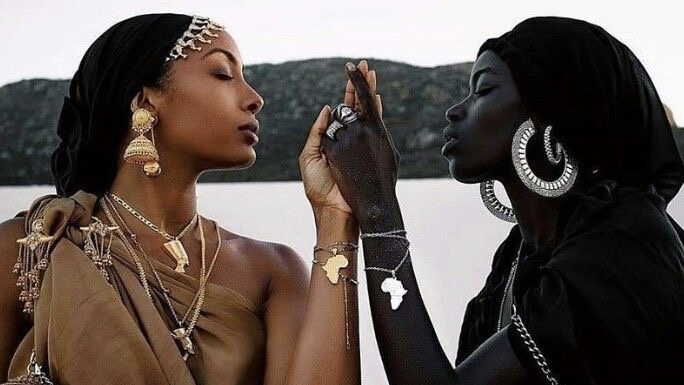
I think one of the greatest things a woman can learn about beauty is that beauty does not have one face.
For a long time, we’ve treated beauty as though it exists through a single lens.
She’s prettier.
Her body is better.
Her face is better.
Men like her more.
She walks into a room and gets more attention.
And suddenly, another woman’s beauty becomes a comparison against our own.
But what happens when you realize that two women can be beautiful in completely different ways?
One woman may be soft and delicate.
Another may be striking and dramatic.
One may have a sensual, almost dangerous beauty.
Another may possess the kind of elegance that feels timeless.
And another may be beautiful precisely because there is something unusual about her that you can’t quite put your finger on.
They aren’t failed versions of one another.
They are different archetypes of beauty.
And once you understand that, comparison starts to make a lot less sense.
Beauty Has Never Been One Thing
The idea that feminine beauty exists in different archetypal forms isn’t new.
Representations of women throughout mythology, literature, art, and history have repeatedly associated feminine beauty with very different qualities: harmony and refinement, sensuality and danger, rebellion and unconventionality.
Helen was not Cleopatra.
Cleopatra was not Aphrodite.
Aphrodite was not a Siren.
Yet all became symbols of feminine beauty.
They simply represented different expressions of it.
So, What Are the Beauty Archetypes?
There isn’t one universal system for categorizing beauty. One popular styling framework, often called the seven style essences, describes seven different visual impressions. Most people may also be a blend rather than fitting neatly into only one.
Dramatic: Striking, bold and commanding. This beauty often has sharpness, intensity or a strong visual presence.
Natural: Relaxed, effortless and approachable. There is often an ease to this beauty that doesn’t need to appear overly constructed.
Classic: Balanced, refined and timeless. Classic beauty tends to give an impression of harmony, polish and elegance.
Gamine: Playful, spirited and youthful. This beauty often combines sharpness with liveliness or mischief.
Romantic: Soft, sensual and mature. Romantic beauty tends to feel lush, feminine and naturally alluring.
Ingenue: Delicate, sweet and youthful. This beauty gives an impression of softness, innocence and gentle femininity.
Ethereal: Dreamy, delicate and otherworldly. There can be something unusual or difficult to define about this kind of beauty.
And here’s the important part: you don’t necessarily have to be only one.
The purpose isn’t to put women into seven new boxes.
It’s to recognize that beauty was never one box to begin with.
You May Not Even Be Competing in the Same Category
Modern beauty culture still works this way, although you wouldn’t necessarily know it from looking at what we’re repeatedly shown. Social media, advertising, beauty trends, and cosmetic procedures have a tendency to feed us the same types of beauty over and over again. The same lips. The same noses. The same body proportions. The same facial features become desirable until we begin mistaking what is currently popular for what is beautiful.
But popularity doesn’t correspond to beauty.
One woman may have a soft, delicate beauty.
Another may be striking and dramatic.
Another may be sensual.
Another may have an effortless, natural elegance.
Another may possess an unconventional face that becomes more fascinating the longer you look at her.
Another may not photograph dramatically but completely commands a room in person.
Yet we look at these completely different expressions of beauty and try to rank them.
Why?
A Siren doesn’t need to become an Ingenue.
A Classic doesn’t need to become a Femme Fatale.
A Dramatic doesn’t need to soften herself to compete with a Romantic.
They’re creating different experiences.
Her beauty doesn’t prove the absence of yours.
It may simply be speaking a different language.
Jealousy Often Begins With a False Comparison
This is where understanding archetypes can become liberating.
You see a woman who possesses something visually different from you, and instead of thinking:
I wish I looked like her.
You can think:
I understand why she’s beautiful.
There’s a difference.
You can recognize another woman’s beauty without immediately turning her into your competition.
She may have enormous eyes and delicate features.
Beautiful.
You may have sharper features and an intense gaze.
Also beautiful.
She doesn’t need yours.
You don’t need hers.
And once you understand your own beauty, you can stop trying to collect every attractive quality you’ve ever seen on another woman.
The Art of Seduction Takes It Even Further
This also reminded me of Robert Greene’s The Art of Seduction.
Greene’s archetypes aren’t really beauty archetypes. They’re archetypes of attraction.
The Siren captivates differently from the Coquette.
The Coquette captivates differently from the Charmer.
The Charmer captivates differently from the Star.
Which introduces another important distinction:
Being beautiful and being captivating are not exactly the same thing.
Your physical appearance is only part of the experience people have of you.
There is also your voice.
Your movement.
Your clothing.
Your eye contact.
Your humor.
Your confidence.
Your restraint.
Your warmth.
Your mystery.
Your intelligence.
Your energy.
The way you make someone feel when they’re standing in front of you.
Two women could both be beautiful and create completely different reactions.
That doesn’t make one superior.
It makes them distinct.
Stop Trying to Become Every Beautiful Woman
This may be one of the biggest traps of modern beauty culture.
We have access to thousands of beautiful women every day.
You open your phone and see one woman’s lips.
Another woman’s waist.
Someone else’s cheekbones.
Someone else’s hair.
Someone else’s eyes.
And if you’re not careful, you start constructing an imaginary woman made from everybody else’s best features, and then comparing yourself to her.
She doesn’t exist.
You were never supposed to embody every beauty archetype.
Maybe your beauty isn’t cute.
Maybe it isn’t intimidating.
Maybe it isn’t overtly sexual.
Maybe it isn’t delicate.
Maybe it isn’t conventional.
That doesn’t automatically make it less powerful.
The question isn’t:
How do I become as beautiful as her?
The better question may be:
What makes my beauty mine?
And once you understand that, enhance that.
Her Beauty Doesn’t Require Your Insecurity
Another woman’s beauty can simply be information.
You can admire her.
You can compliment her.
You can even borrow inspiration from her.
But you don’t have to turn admiration into self-rejection.
Understanding archetypes gives us language for something we’ve probably always intuitively known:
Women can be beautiful in fundamentally different ways.
There is no requirement that the most beautiful woman in the room can be the only beautiful woman in the room.
Maybe there isn’t supposed to be a winner at all.
Maybe she’s the Siren.
Maybe you’re the Classic.
Maybe she’s soft where you’re striking.
Maybe she’s mysterious where you’re warm.
Maybe she walks into a room and immediately commands attention.
Maybe you’re the woman people can’t stop thinking about after she leaves.
Different beauty.
Different effect.
Different archetype.
And perhaps once we understand that, we can look at another beautiful woman and simply think:
She’s beautiful.
Without needing to add:
Does that mean I’m not?
References
Hwang, K. (2025). Mythic Geographies of Feminine Beauty: Ancient Archetypes and Their Influence on Modern Esthetic Ideals. Journal of Craniofacial Surgery. doi:10.1097/SCS.0000000000011676.
For further reading on the seven style essences: The Concept Wardrobe, “The 7 Style Essences Explained.”






Leave a Reply